Touba Ghadessi at Wheaton

Touba Ghadessi, Associate Professor of Art History and Associate Provost at Wheaton College, will talk about her recently published book, Portraits of Human Monsters in the Renaissance: Dwarves, Hirsutes, and Castrati as Idealized Anatomical Anomalies. It focuses on the ways in which human difference has been historically represented, categorized, and interpreted in various Italian and French courts of the Renaissance.

The talk will be available for viewing via Livestream.

The event is also open to the public, in person, at in the Holman Room of Mary Lyon Hall at Wheaton College (calendar details).

Researchers at URI Seeking Collaborators

Researchers at the University of Rhode Island are seeking possible collaborators; these collaborations may apply for NEHC seed grant funding. They are particularly interested in the following topics:

  • How to change fish-eating habits
  • Connecting jazz and philosophy
  • Radiation and cover ups

Interested researchers at NEHC member institutions should contact Annu Palakunnathu Matthew at urihumanities@uri.edu for more details.

2019 Call for Proposals of the Thomas Jefferson Fund

The 2019 Call for Proposals of the Thomas Jefferson Fund is open until March 5, 2019 | 12:00pm (midday) EST.

This program, launched by the Embassy of France in the United States and the FACE Foundation, aims to encourage and support cooperation among the most promising young French and American researchers, and foster forward-looking collaborative research projects.

Each selected French-American project will receive up to $20,000 over a period of two years.

Applications are accepted in the three following fields: Humanities and Social Sciences (HSS), Science, Technology, Engineering and Mathematics (STEM), Science for Society (interdisciplinary STEM-HSS projects).

In support of the Make Our Planet Great Again Initiative launched by President Emmanuel Macron in June 2017, the Thomas Jefferson Fund is offering additional grants this year for research projects related to Earth System Science, Climate Change and Sustainability, and Energy Transition.

Interested parties are invited to get more information and to apply here: http://face-foundation.org/thomas-jefferson-fund/.

An Interview with Laurie Essig

Laurie Essig is Professor of Gender, Sexuality, and Feminist Studies at Middlebury College. On February 14, she will be giving an NEHC-sponsored talk at Northeastern University. In anticipation of this event, Matt Guariglia asked Professor Essig a few questions.

First, I was wondering if you could tell us a little bit about your current project and what it is you’ll be lecturing about. 

My latest book — out this week — is Love, Inc. Dating Apps, the Big White Wedding, and Chasing the Happily Neverafter (UC Press). Love, Inc. argues that in the US we have turned to romance with a vengeance in the past several decades. In part that is because romance gives us hope for a better future. All we have to do is meet “the one” (and have the most spectacular engagement, the perfect wedding, and the most romantic honeymoon) and then we too can live happily ever after. Even as most Americans became poorer and the world begins to come to terms with the effects of global climate change, romance promises that tomorrow can be safe and secure. I’ll be talking about why romance is so central to capitalism, particularly the sort of neoliberal capitalism that took hold in the 1980s and why we believe in the promise of romance even though we know deep down love is not all we need.

The name of the lecture series is “Times Up: What now?” do you have any thoughts about what direction you would like to see the current movement headed in?

I think Time’s Up for fantasizing about a privatized future, one where we are safe and secure in a castle on a hill with our Prince/ss Charming. The truth is we can no longer imagine our futures as individual projects as the polar vortex and monster storms bear down on us. We can no longer imagine ourselves finding financial well-being by getting saved by Prince Charming (or a Vampire named Edward Cullen or whatever the current fantasies are). Instead, we need to pay attention to structure, to history and to economy before it’s too late. Or maybe it already is and it’s just the romantic in me that imagines there might somehow be more time to get things right.

The talk you are giving focuses on the love industry and digital dating, in an era where we are all having this heightened conversation about gender and power, do you see these technologies and industries unbalancing some of the dynamics or reinforcing them? 

I don’t think technologies per se are more or less misogynist or racist, but rather because racism and misogyny are so prevalent on social media platforms, it seems more “normalized” like it really is “#yesallmen” and “#yesallwhitepeople.” This certainly can start to see normal on dating platforms. Just look at Tinder and Grindr and being racist and sexist (and fat phobic and ageist and ablest, etc.) starts to seem depressingly widespread. And the platforms themselves have done little to regulate this kind of profile. But I am heartened by the fact that users (often women and/or people of color) are getting together to fight back with their own forms of public shaming like “Douchebags of Grindr” and “Bye Felipe” where the kind of men who create toxic cultures on dating apps are called out for it.

You’re giving this talk across a number of NEHC campuses, do you find particular value in getting this message to college students? Do you think the NEHC model of giving talks at multiple regional institutions allows you to think and address these issues in a new or intriguing way? 

What’s been fun is talking to students about all this. For two decades I have been teaching a course on the Sociology of Heterosexuality and my students always complain that I have destroyed their childhoods and their fantasies for the future. But I always point out that all of them will go off and have a big white wedding and a diamond ring anyway because that’s the power of hegemonic ideology. But I like to think that they at least learn to resist and subvert some of the conventions of romance and maybe, just maybe, they are paying a lot more attention to how to healthcare for all or forgive student loan debt than what kind of flowers they’ll have on their big day. The other interesting thing is that I have been talking to students at Tufts and Dartmouth about my other work on queerness in Russia (something that I have been doing for nearly three decades now). It’s kind of the polar opposite of a wedding: widespread homophobia and violence. And yet, I think it’s really important to point out how in both the US and Russia, sexuality is central to our notions of citizenship and being a patriot and so in some ways the pressure to engage in the rituals and costs of romance is intertwined with violence and hatred of those who refuse to participate.

Flyer for Essig's talk "Love, Inc."

Laurie Essig at Northeastern University

Celebrate V-Day the feminist way! Laurie Essig, author of Love, Inc., will give a talk at Northeastern University on February 14 on her new book, which encourages readers to think about romance as ideology.

Essig is Professor and Director of Women’s, Gender, and Feminist Studies at Middlebury College. The NEHC is providing support for this event!

56th Wallace Stevens Poetry Program with Claudia Rankine

Claudia Rankine, a MacArthur “Genius” and National Book Critics Circle Award winner, will read from her work at UConn’s main campus in Storrs and at the Greater Hartford Classical Magnet School on March 13, 2019.

She will appear at 12:30 p.m. on Wednesday March 13 at the at the Greater Hartford Classical Magnet School, 85 Woodland St, Hartford. She will offer a second reading at 7 p.m. that night at the Konover Auditorium of the Dodd Center,405 Babbidge Road on the UConn Storrs campus. Both readings are free and open to the public.

Rankine is the author of five collections of poetry including Don’t Let Me Be Lonely (Graywolf 2008) and the bestsellingCitizen: An American Lyric (Graywolf 2014), which uses poetry, essay, cultural criticism, and visual images to explore what it means to be an American citizen in a “post-racial” society. As the Judges Citation for the Jackson Prize notes, “The moral vision of Claudia Rankine’s poetry is astounding. In a body of work that pushes the boundaries of the contemporary lyric, Rankine has managed to make space for meditation and vigorous debate upon some of the most relevant and troubling social themes of the 20th and 21st centuries.” Among her numerous awards and honors, Rankine is the recipient of the Forward Prize for Best Collection, the NAACP Image Award, the PEN Open Book Award, and the LA Times Book Award for poetry as well as fellowships from the Lannan Foundation and the National Endowment of the Arts.

The Wallace Stevens Poetry Program began in 1964 with funding from The Hartford to honor modernist master poet Wallace Stevens, a former vice president of The Hartford. In the last half century, the program has brought a roster of the most important national and international poets to Connecticut. This year’s program is sponsored by The Hartford, with additional support from UConn’s African American Cultural Center and the College of Liberal Arts and Sciences’ English Department, Humanities Institute, and Creative Writing Program. For more information, please visit our website at http://wallacestevens.uconn.edu/

Living Objects: African-American Puppetry

The University of Connecticut is hosting Living Objects, an exhibition, festival, and symposium on African-American puppetry.

Activities for the Living Objects: African American Puppetry Festival and Symposium will take place in various venues on UConn’s Storrs campus Feb. 8 to 10, with related festival events with UConn Hartford at the Hartford Public Library on Thursday, Feb. 7, 2019, and at the Wadsworth Atheneum Museum of Art on Saturday, Feb. 9, 2019.

Attendees have two options to participate in Living Objects Festival and Symposium events:

  1. Living Objects performances in Storrs and Hartford are open to the public. Individual tickets can be purchased at bimp.ticketleap.com.
  2. To attend all Living Objects Festival and Symposium events, including performances, panel discussions, film screenings, and more, registration is required. Registration can be completed at www.cvent.com/d/bbqbh7.

These events are part of the current Ballard Institute exhibition Living Objects: African American Puppetry, on display through April 7, 2019, which for the first time brings together historical and contemporary puppets, masks, and performing objects by African American artists and puppeteers. Many of the exhibition’s contributors, as well as scholars from around the United States, will come together at the festival and symposium to celebrate the past, present, and future of African American puppetry.

Exhibition co-curator Paulette Richards, a teaching artist and Fulbright Scholar, writes that “since their arrival in the Americas, African people have animated objects in a rich variety of forms and contexts, animating objects to represent their experiences and identity.” The Living Objects: African American Puppetry Festival and Symposium will highlight such work by contemporary African American artists, while also contextualizing the evolution of African American object performance.

Artists and puppeteers performing in the festival and symposium include Tarish “Jeghetto” Pipkins, Megan Piphus, Nehprii Amenii, Schroeder Cherry, David Liebe Hart, Dirk Joseph, Pandora Gastelum, Brad Brewer, Gabrielle Civil, Bruce Cannon, Nate Puppets, Yolanda Sampson, Edna Bland, and Paulette Richards.

NEH Reopens on Monday

Both the National Endowment for the Humanities (NEH) and the National Endowment for the Arts (NEA) will reopen on Monday. While FY 2019 funding has yet to be resolved for the agencies and the partial government shutdown continues both agencies have identified administrative funds remaining for FY 2018 that will allow them to operate, and pay employees, for approximately four weeks. In a brief statement, the NEH announced that the agency “will prioritize the grant review process in order to minimize any interruption in the awarding of federal funding. Reopening now coincides with the critical workload in mid-January through February that is necessary to award the spring grants.”

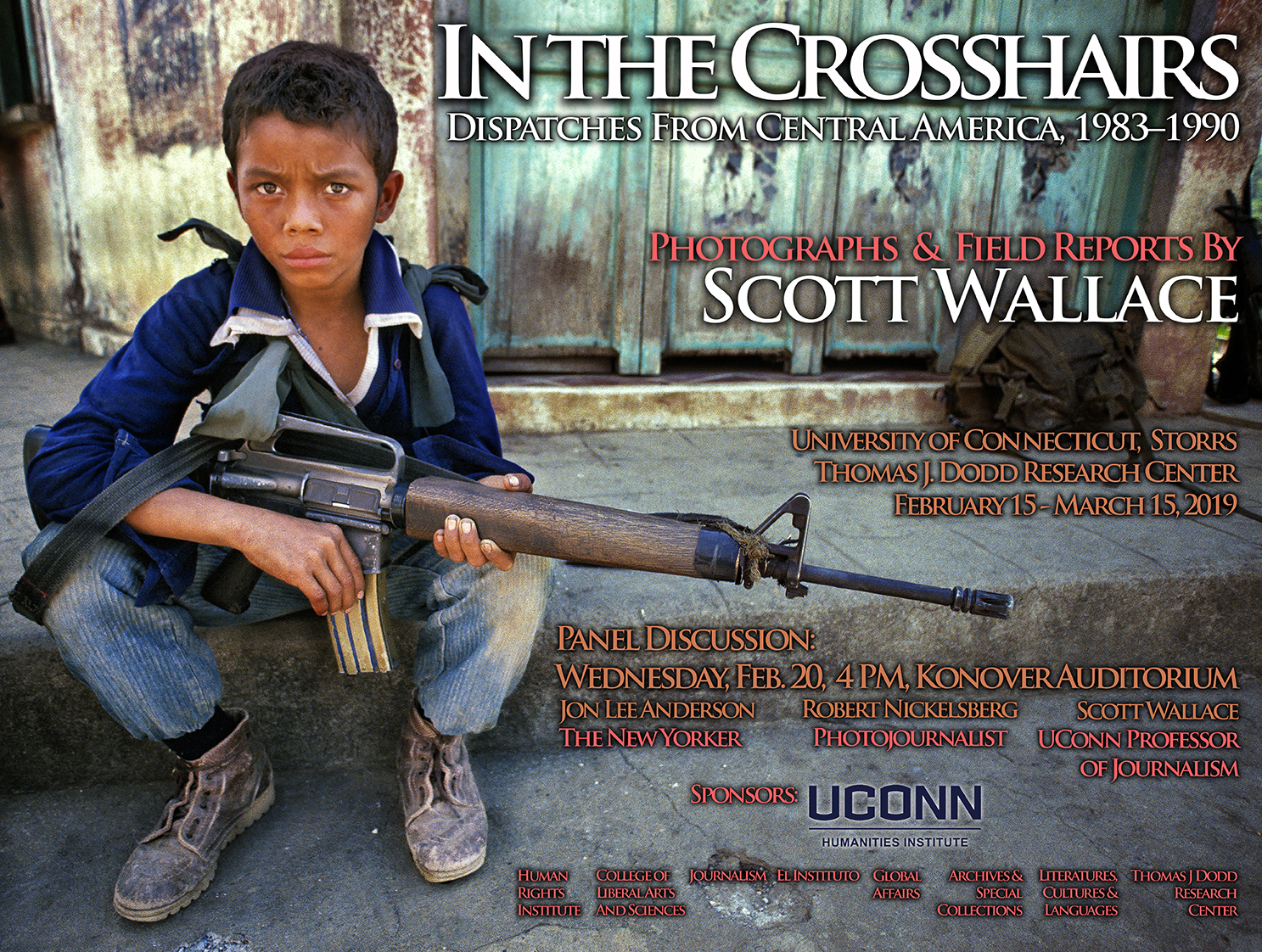
Poster of young boy with gun for In the Crosshairs talk

In the Crosshairs: Dispatches from Central America 1983-1990

University of Connecticut, Storrs is hosting In the Crosshairs: Dispatches from Central American 1983-1990, featuring the photographs and field reports of Scott Wallace, February 15–March 15 at the Thomas J. Dodd Research Center.

A panel discussion featuring Wallace, Jon Lee Anderson of The New Yorker, photojournalist Robert Nickelsberg will be held on February 20, 4PM, at the Konover Auditorium.

Scroll to top